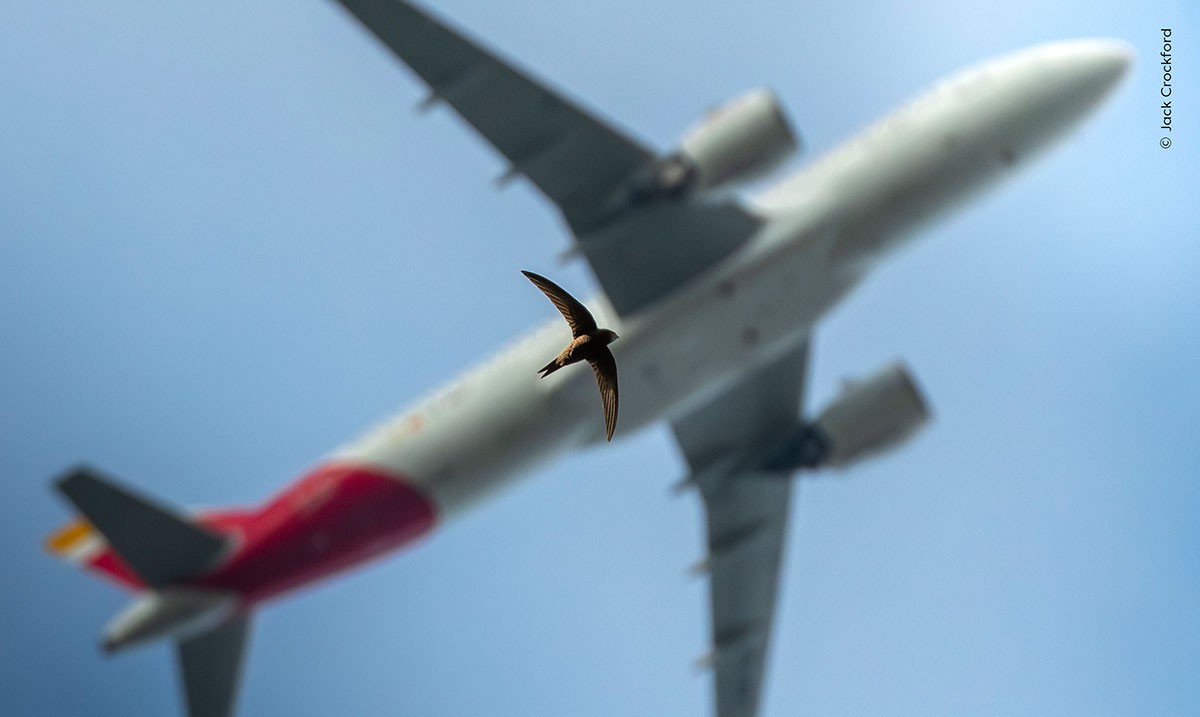
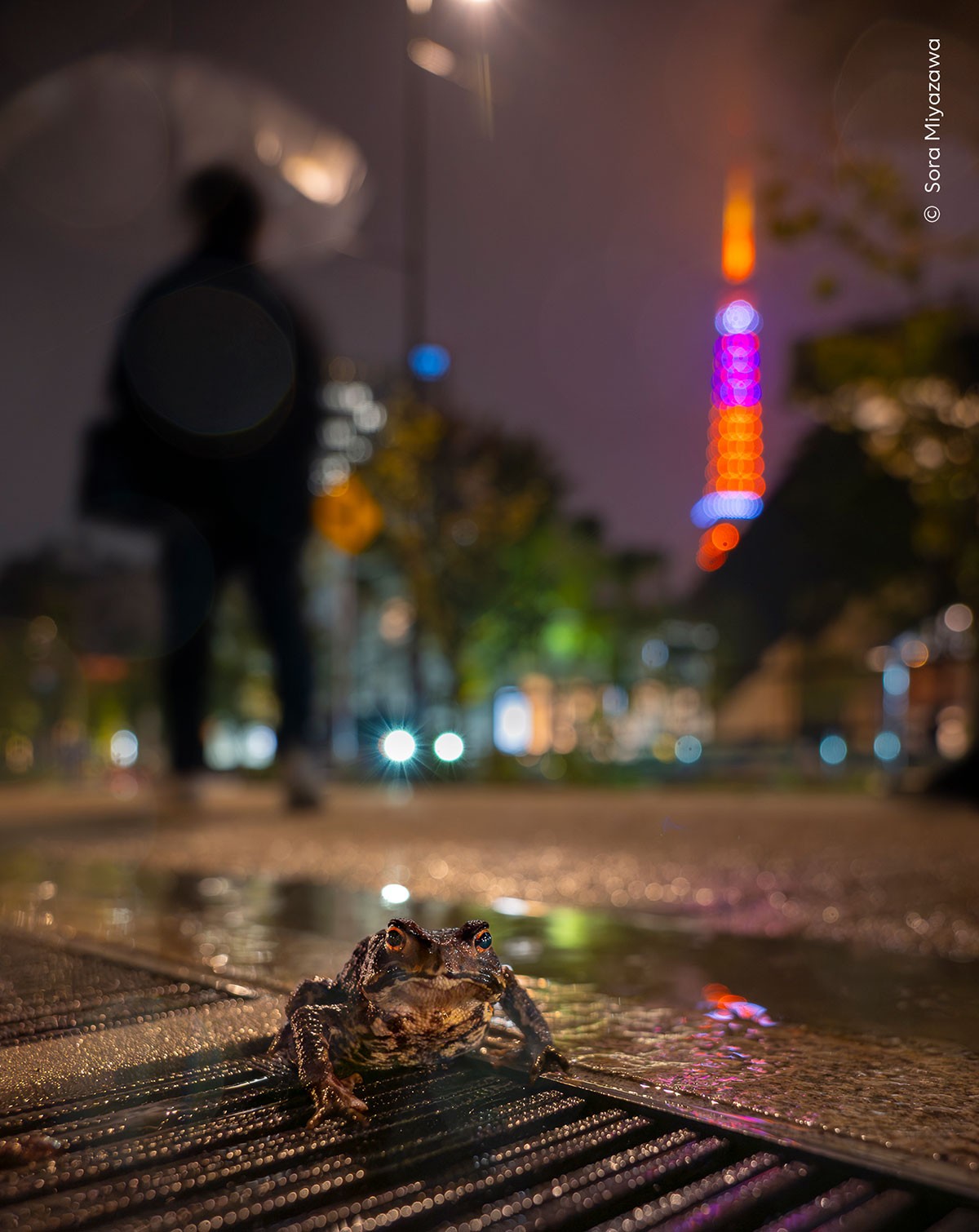
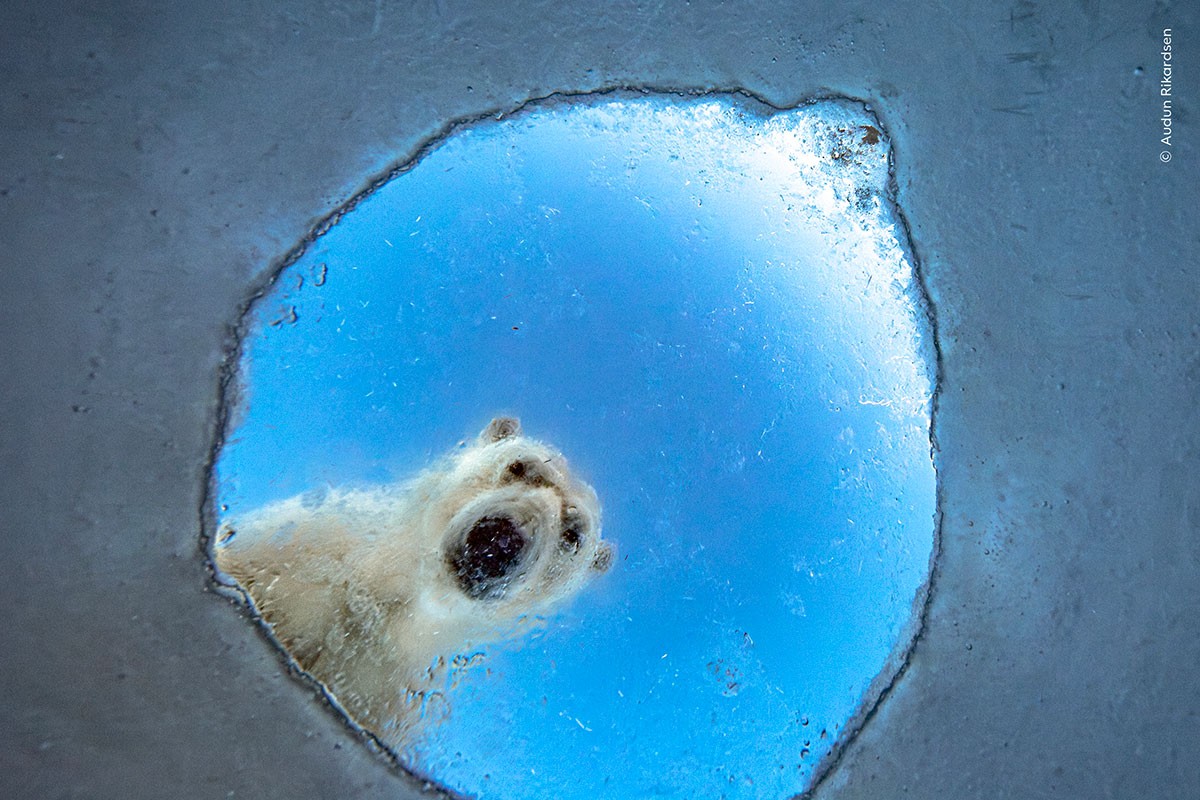
Un orso polare che scruta il foro nella banchisa creato da una foca per respirare. Un rondone che vola a bassa quota sotto la sagoma di un aereo in arrivo all’aeroporto di Heathrow. Un rospo che passeggia per le strade di Tokyo dopo un acquazzone. Sono solo alcune delle 100 immagini finaliste alla 62esima edizione del Wildlife Photographer of the Year, il più prestigioso concorso di fotografia naturalistica al mondo promosso dal Natural History Museum di Londra, che decreterà i vincitori il prossimo 13 ottobre. Il concorso, che racconta la bellezza e la diversità della natura richiamando l’attenzione sulle minacce che mettono a rischio specie e habitat, ha ricevuto quest’anno un numero record di candidature, con oltre 65mila scatti provenienti da 121 Paesi e territori. Nella galleria fotografica sotto, alcune delle immagini.
- The Art of Flying by Jack Crockford A common swift flies below a commercial aircraft, with their shapes mirroring each other. Overlaid text reads “© Jack Crockford”. Is it a bird? Is it a plane? It’s actually both! In the midst of London, the image Jack had been hoping to create finally became a reality. He captured the perfect moment a plane heading towards Heathrow Airport and a common swift soared in synchrony overhead. Just like those aboard the plane, the swifts were arriving in London. These long-distance travellers were reaching the end of their annual migration from southern Africa to their breeding grounds in northern Europe. Somewhat similar to a commercial plane, swifts have long, scythe-shaped wings, giving them speed and manoeuvrability in the air. In fact, these aerial experts spend most of their time on the wing, usually only landing when it’s time to breed.
- Urban Wanderer by Sora Miyazawa A toad sits on a wet city street, partly lit by the glow of Tokyo Tower in the distance, as a person walks by. Overlaid text reads “© Sora Miyazawa”. Sora chanced upon this Eastern Japanese toad in the heart of Tokyo – one of the world’s largest cities and a thriving urban centre. The toad paused just before hopping back into the bushes, giving Sora the perfect chance to compose this image of the amphibian lit by the soft neon glow of the city. Exactly how these toads survive in a city of 14 million people is unclear. That being said, toads do tend to be more adaptable to new habitats, including urban environments, than other amphibians.
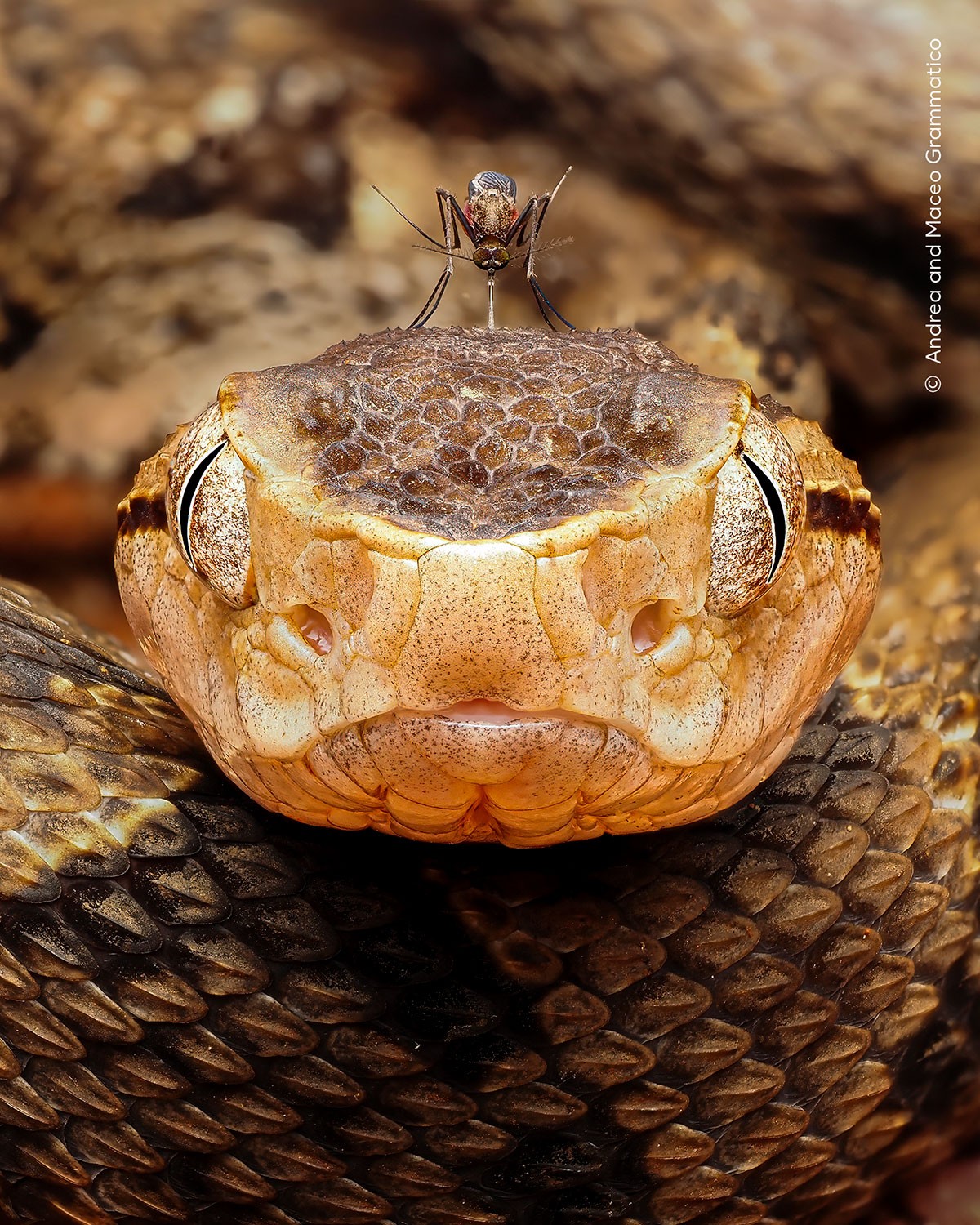
- Biting Back by Andrea and Maceo Grammatico A fer-de-lance snake with a mosquito perched on its head stares into the camera lens. Overlaid text reads “© Andrea and Maceo Grammatico”. Like us, did you find yourself so captivated by the unblinking stare of this fer-de-lance that you failed to spot the surprise guest in this image? Even twins Andrea and Maceo only noticed the mosquito perched on the pit viper’s head later when they were reviewing their photos from Sierpe, Costa Rica. It took lots of concentration and care for them to produce this photo, combining multiple images that have different points of focus. Fer-de-lance are highly venomous snakes. Despite only biting people in defence, they’re so toxic that they’re responsible for the greatest number of fatal snakebites in Central America. Unsuspecting workers in agricultural plantations are often caught out by their highly effective camouflage.
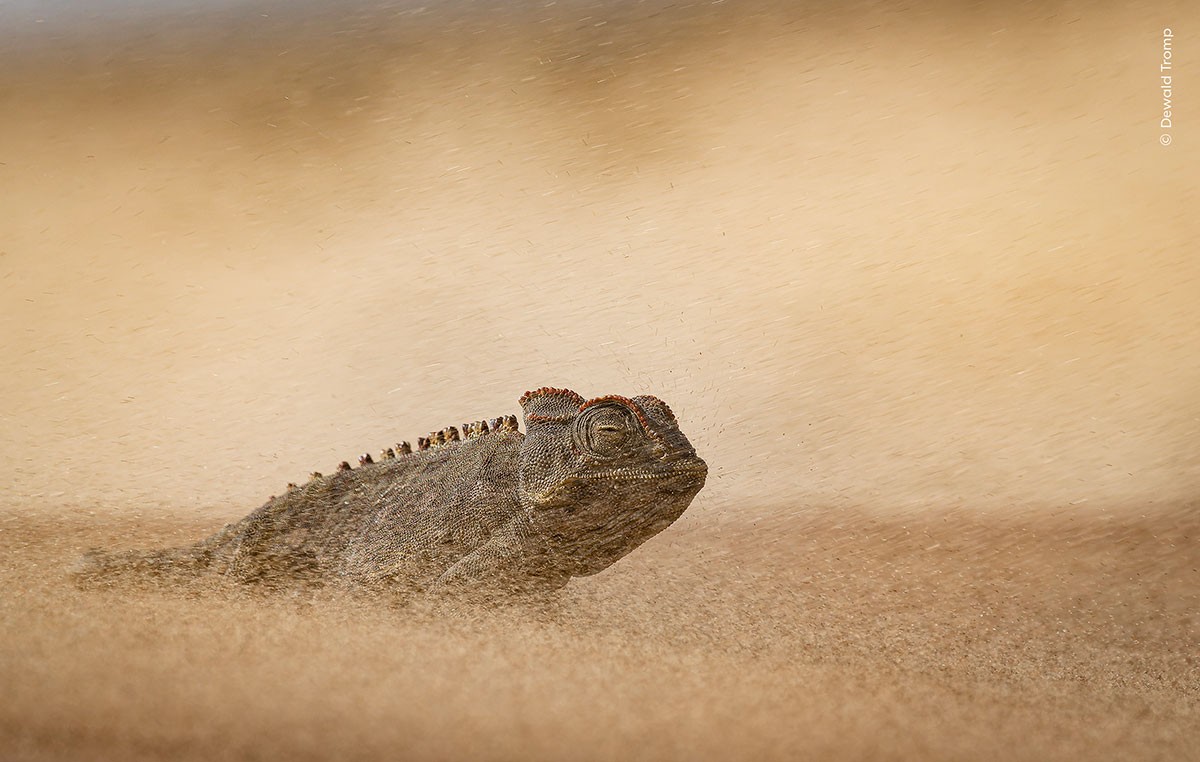
- Eye of the Storm by Dewald Tromp A small brown chameleon in the middle of a sandstorm. Overlaid text reads “© Dewald Tromp” Stretching more than 2,000 kilometres across the western coasts of Angola, Namibia and South Africa is a vast desert called the Namib. It’s one of the most extreme environments on Earth. As Dewald worked near Swakopmund in Namibia, a sudden storm whipped up the sand, making the air unbreathable and reducing visibility to almost zero. Facing it all head on – literally – was this little Namaqua chameleon. The tactics these insect-eating desert specialists use for staying hydrated are truly fascinating! Microscopic grooves in their skin channel the tiny droplets of dew that form on their bodies into their mouths. These chameleons also drink fog water that condenses on plants, rocks and sand.
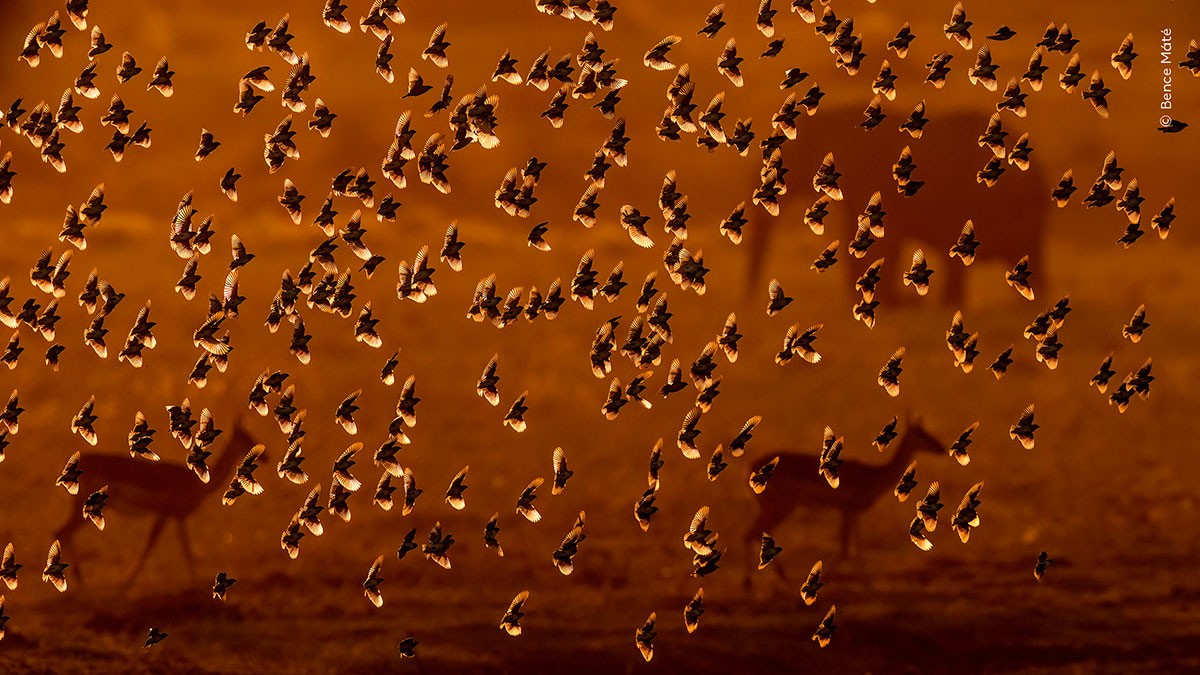
- Flock of Gold by Bence Máté A large flock of red-billed queleas in flight, partially obscuring the elephant and antelopes beind them. Overlaid text reads “© Bence Máté”. Even from 30 metres away, Bence could feel the rush of air from the tens of thousands of small wings in this flock of red-billed queleas. This late afternoon scene in Kenya’s Tsavo East National Park only lasted a few minutes, but it was enough time for Bence! He captured the moment when the enormous flock partially obscured several large mammals visiting a nearby pond. Red-billed queleas are the most abundant birds on Earth. They’re found in almost every part of central, eastern and southern Africa. The adult breeding population of this sparrow-like species is thought to be made up of a staggering 1.5 billion individuals! Sometimes, two million of these birds will gather in one place.
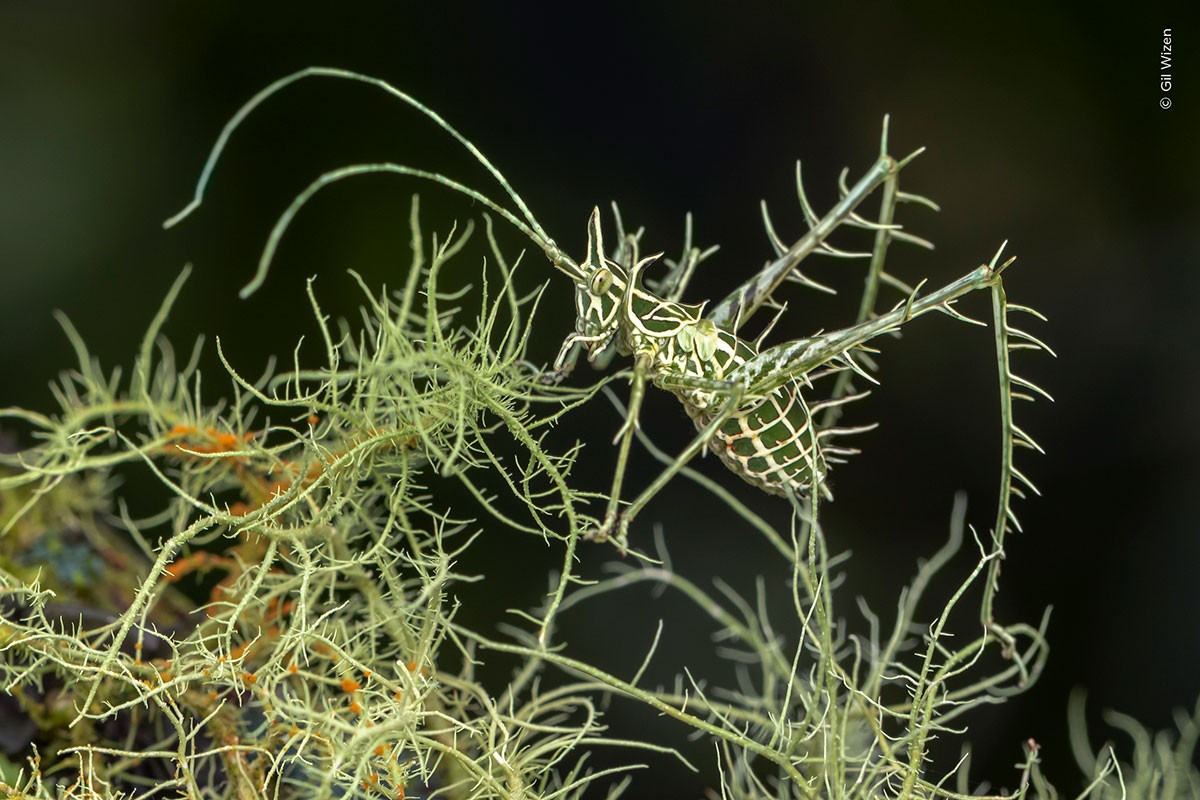
- Hidden Dragon by Gil Wizen A katydid covered in long green spines camouflaged perfectly with the lichen it’s standing on. Overlaid text reads “© Gil Wizen”. Can you spot the cunningly disguised insect in this image? It’s a Lichenodraculus matti katydid, also known as Matt’s little lichen dragon. This little katydid is just 15 millimetres long and is only found in the Andes Mountains in Ecuador. So, it’s pretty hard to find even before you take its incredible camouflage into consideration. The katydid blends in seamlessly with the lichen it lives on, while its spiny armour protects it against even the most eagle-eyed predators. For Gil, telling the lichen and katydid apart in the camera’s viewfinder proved challenging. It was only when the insect moved slightly that he could see it.
- Icy Window by Audun Rikardsen A photo taken from underwater looking up as a polar bear peers down through a hole in the ice. Overlaid text reads “© Audun Rikardsen”. Imagine being a seal and looking up and seeing this! Seals use gaps in the ice to come up to breathe, but to do so can be dangerous! Polar bears seek out these holes, lying in wait looking to snag their next meal. It’s a strategy that works in winter, but in summer, when there’s no ice, the bears are forced to spend several months on land. In these lean times they have to survive on their stored fat reserves. Audun spotted bear tracks close to this hole in the sea ice north of Svalbard, Norway. In anticipation, he drilled another hole nearby to put his camera down into and attached a motion sensor. Some eight hours later, a polar bear finally arrived and looked down.
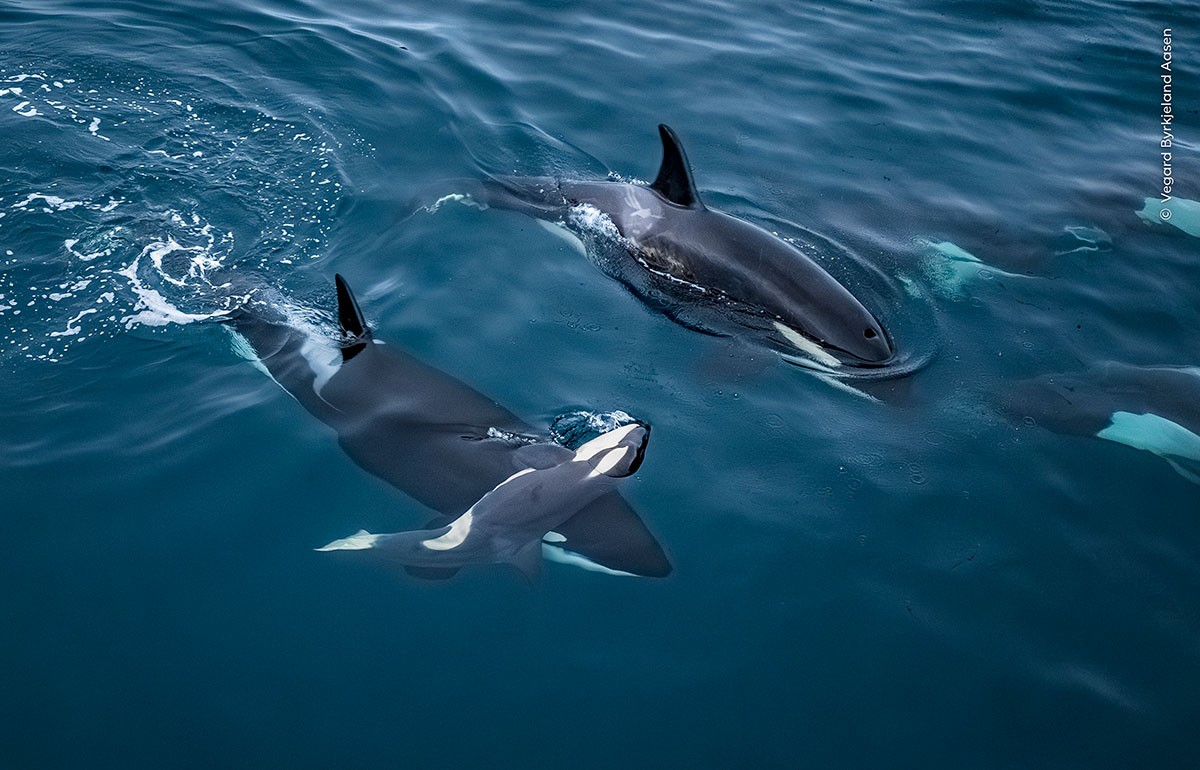
- Lifted to the Surface by Vegard Byrkjeland Aasen A pod of orcas swimming together. One s carrying a dead orca calf on its head. Overlaid text reads “© Vegard Byrkjeland Aasen”. Vegard felt this was an important moment to document. While using a drone during the Norwegian Orca Survey, he spotted an adult orca carrying a dead calf on its head. Occasionally, the orca would drop the calf and retrieve it as it sank. Cetacean mothers will sometimes lift their newborn calves up to the water’s surface to breathe. What Vegard saw may have been the orca attempting to revive the small calf. Some researchers interpret such behaviour as a reflection of the strong bond between mothers and calves. In fact, orca families are closely bonded throughout their lives. Both male and female offspring tend to stay within the group they’re born into. This is actually quite rare! In most other animal groups, at least one of the sexes will leave. But even well into adulthood, massive male orcas will be found still swimming alongside their mums.
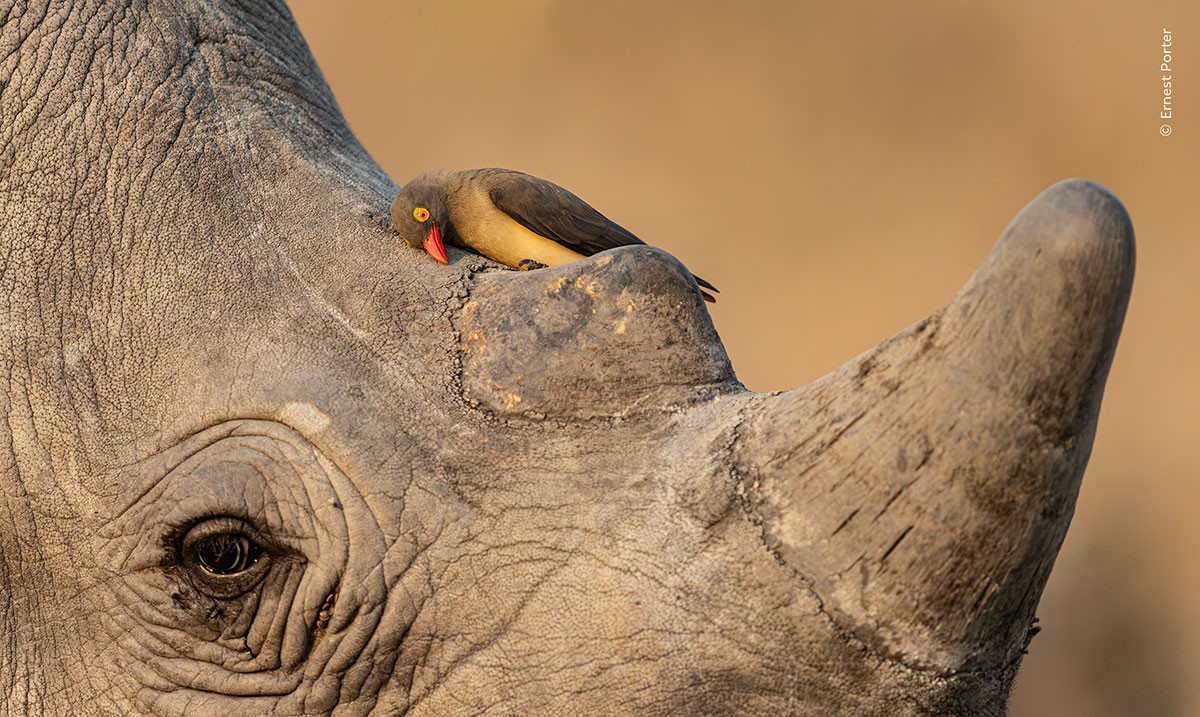
- Mutual Friends by Ernest Porter A red-billed oxpecker perched on a rhinos face, cleaning its bill on the mammal’s skin. Overlaid text reads “© Ernest Porter”. Rhinos and oxpeckers have a close relationship! The birds get a good meal by plucking parasites from the rhino’s skin. In return, the rhinos benefit by having their parasite load kept under control. Not just that, the oxpeckers also act as lookouts, warning the rhinos of impending danger. In fact, the bird’s name in Swahili – askari wa kifaru – translates as ‘the rhino’s guard’ in English. This kind of relationship, where all species involved benefit, is called mutualism. Ernest composed this photo in South Africa’s Manyeleti Game Reserve. Look closer and you’ll see the subtle blue ring in this rhino’s eye that so captivated him.
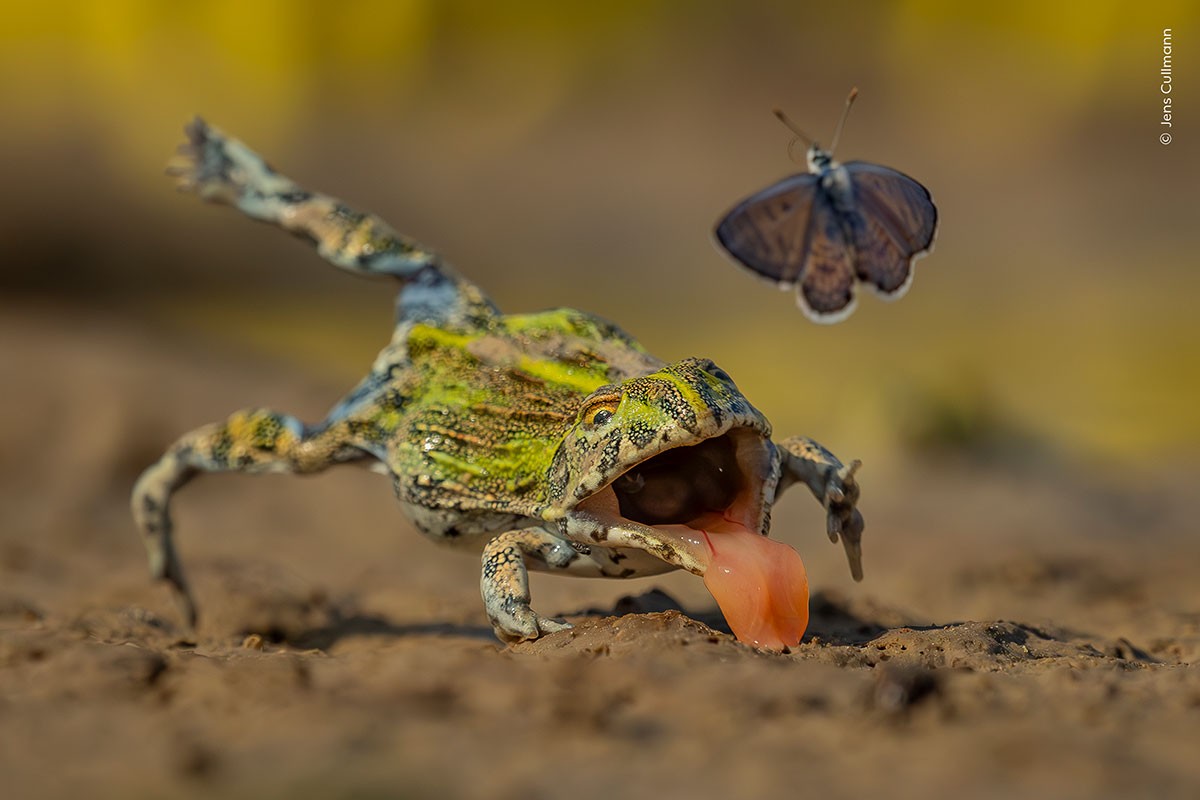
- Split-Second Escape by Jens Cullmann An open-mouthed young toad leaps at a butterfly as it flits away into the air. Overlaid text reads “© Jens Cullmann”. On a visit to the Central Kalahari Game Reserve in Botswana after heavy rains, Jens noticed a great number of tadpoles. Returning the following month, he found ponds and puddles full of young African bullfrogs on a quest for survival, eating just about anything that moved. Jens spent two weeks observing the young frogs. He captured this moment when one determined individual lunged for an African babul butterfly. Not every hunt can be a success as the frog found when its quarry flitted away to safety just in time.
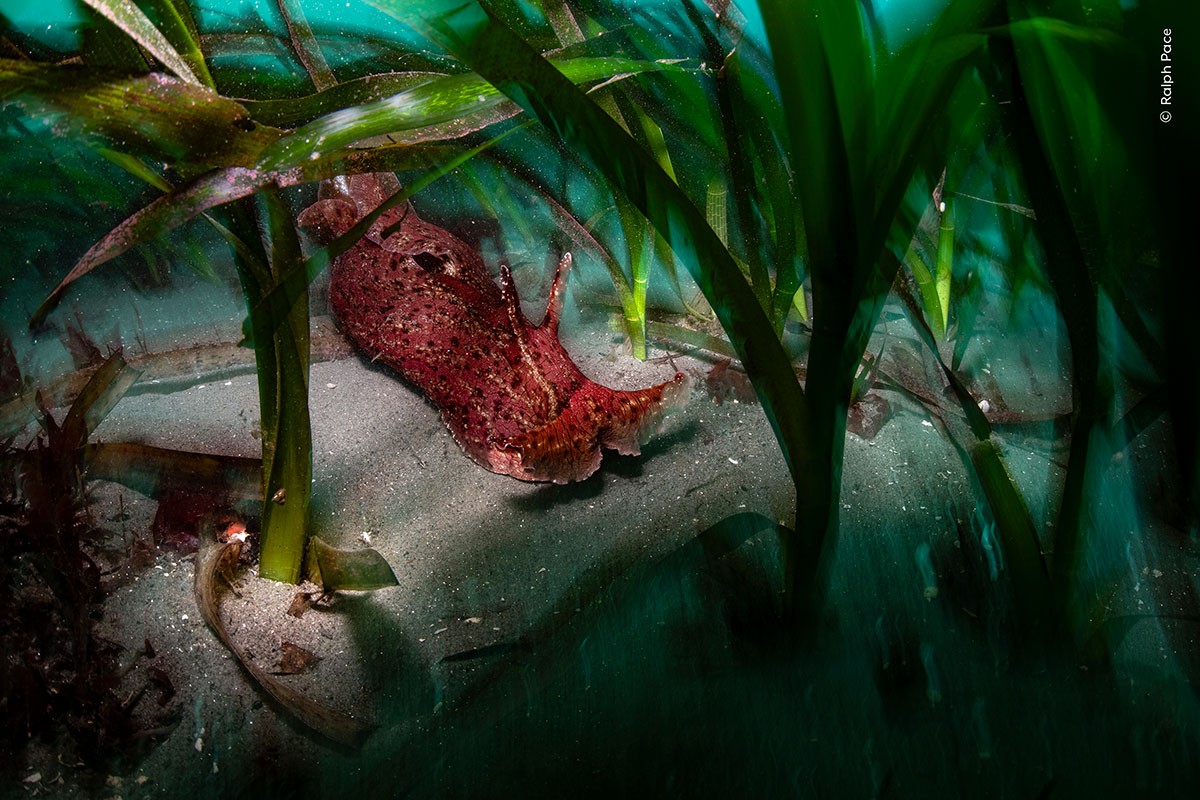
- Ocean Protector by Ralph Pace A russet-coloured sea hare with small, darker spots moves along a sandy seabed between fronds of eelgrass. Overlaid text reads “© Ralph Pace”. This curious creature is a sea hare, a species of sea slug found along the western coasts of California, USA, and northern Mexico. In the evening light in Monterey Bay, Ralph’s image traces the silhouette that gives this marine gastropod its unusual name as it makes its way through an eelgrass bed. Eelgrass is a marine plant, not a seaweed, and the underwater meadows it grows in are vital for coastal ecosystems. They’re also a valuable carbon sink. By grazing on red algae that blocks out sunlight, sea hares help restore eelgrass meadows, allowing these important ecosystems to thrive.
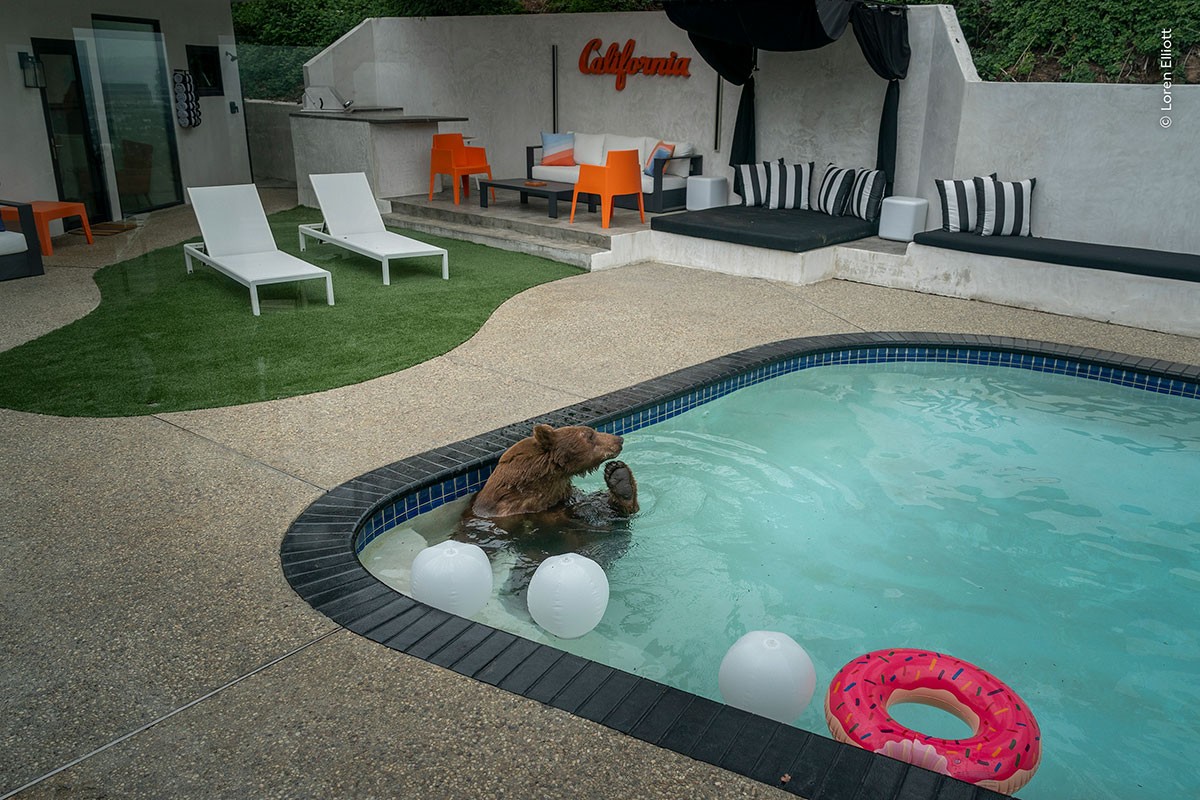
- Pooltime Pastime by Loren Elliott A black bear sits on the steps of a swimming pool in the yard of a private residence. Overlaid text reads “© Loren Elliott”. It appears to have been a relaxing day at the pool for this American black bear in Los Angeles County, USA, but Loren’s image underscores a growing situation in southern California. With the spread of housing developments into bear habitat, human-bear co-existence is increasingly challenging. Bears frequently visit this particular yard and pool in Monrovia, California. The owner is as responsible as possible, keeping their windows and doors shut and making sure to not leave food out. They’re only too aware they’re living in bear country!
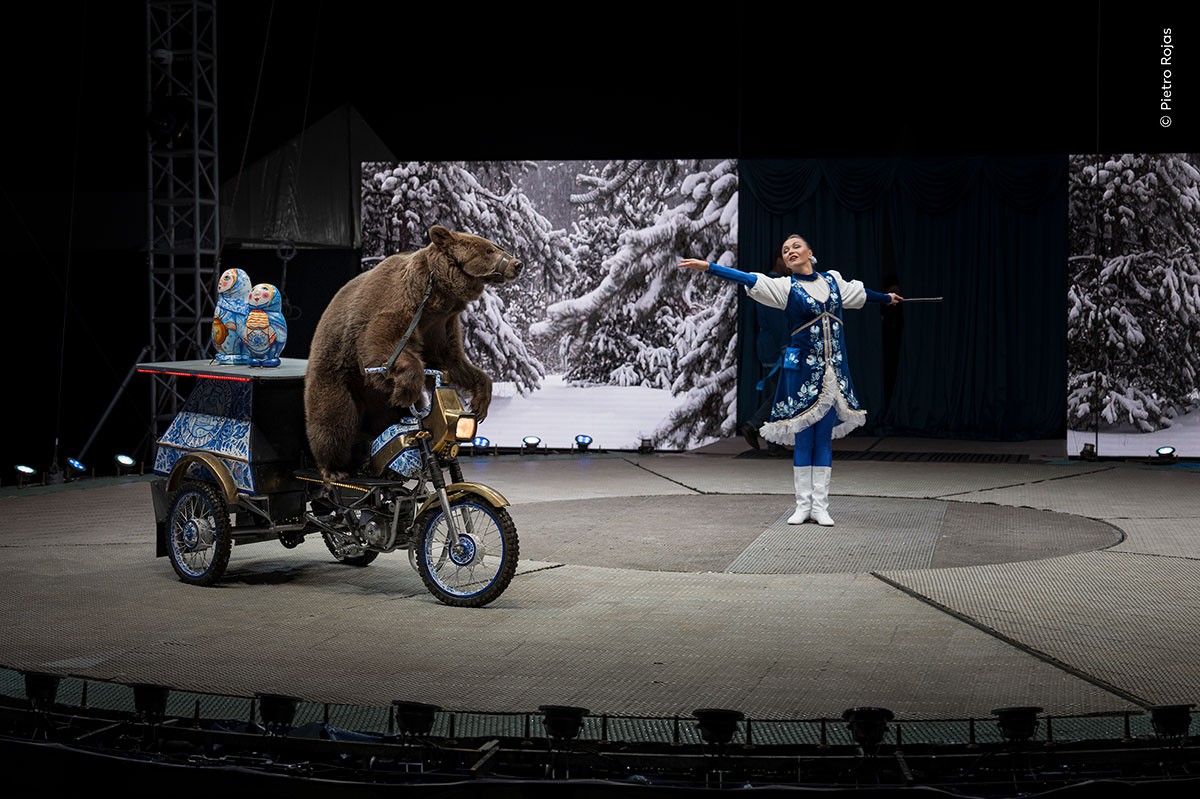
- The Show Goes On by Pietro Rojas A bear rides a small, painted motorbike around a circus ring with a woman at its centre. The backdrop is a painted snowy forest scene. Overlaid text reads “© Pietro Rojas”. Many countries have banned the use of wild animals in circuses, but not all! When a travelling circus with animal acts made a stop in Doha, Qatar, photographer Pietro decided to document it. His image immortalises the moment a captive brown bear ‘performs’, riding a small motorcycle around a circus ring. Bears have been used in acts to entertain people for many hundreds of years. Where they’re still being exploited for entertainment, they’re often trained to hold unnatural poses and postures for long periods of time, contributing to health and behavioural issues.
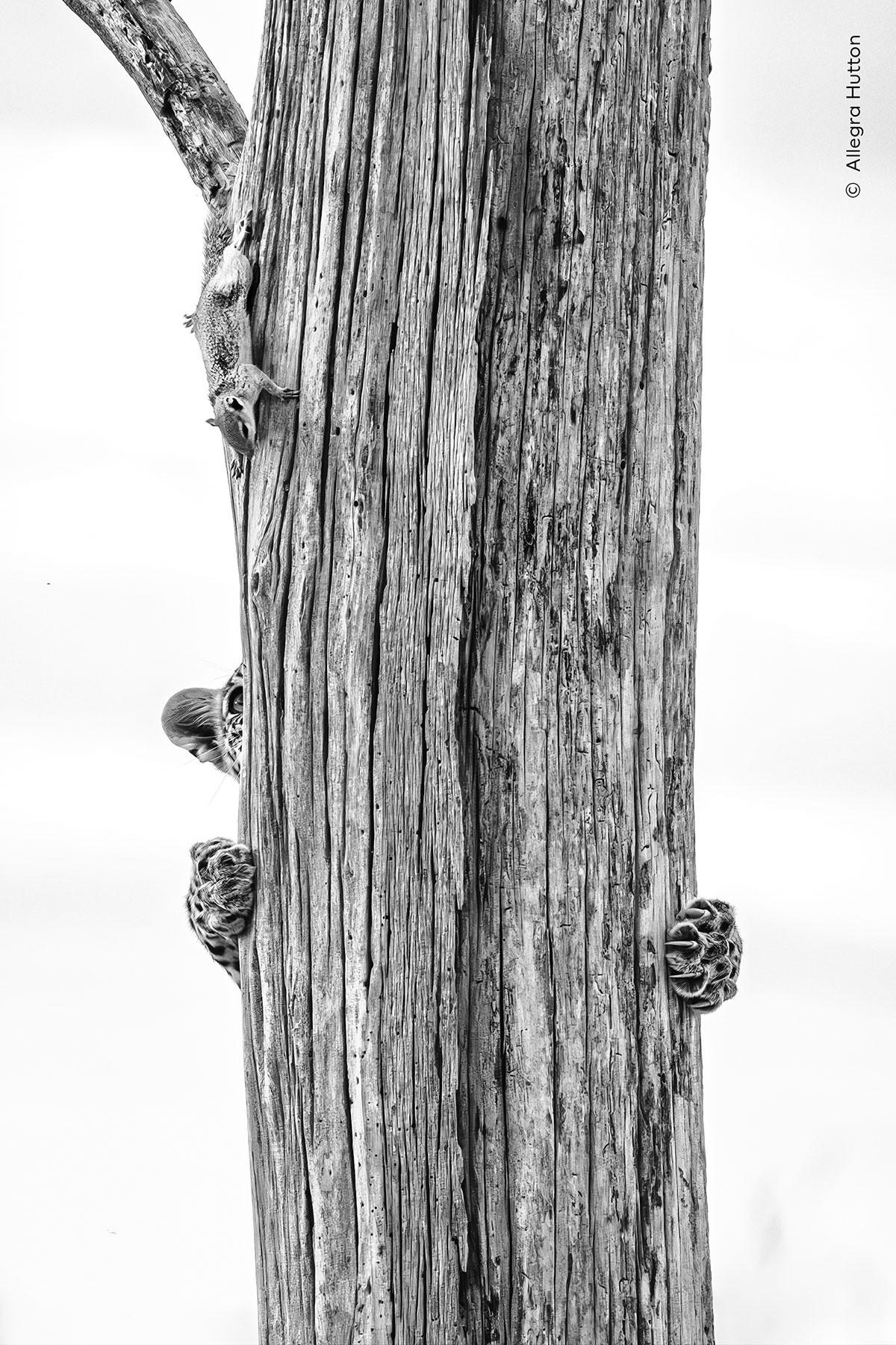
- Up a Tree Without a Squirrel by Allegra Hutton A black and white image of a tree. A squirrel is positioned on the front and a leopard peeks around from the other side of the tree. Overlaid text reads “© Allegra Hutton”. Life can be tough if you’re a leopard! They’re usually expert tree climbers, but this one in Botswana was no match for the tree-scaling skills of a small squirrel. The wily rodent eventually climbed too high for the leopard to follow and the clumsy cat, barely able to cling on, had to admit defeat and make an awkward retreat. For the hungry leopard, this was at least its second failed attempt at catching dinner that day – Allegra also saw it fail at stalking a rabbit.
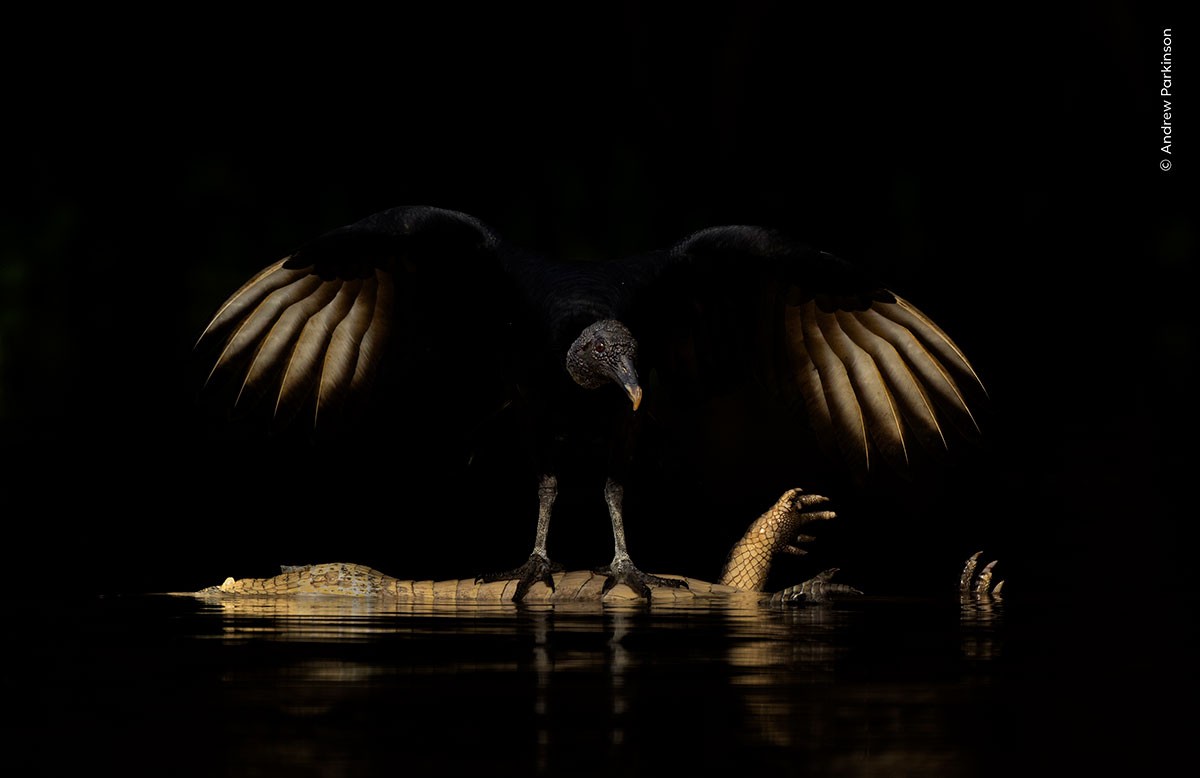
- Wings of Darkness by Andy Parkinson A vulture perches on a dead caiman, with its wings outstretched. Overlaid text reads “© Andy Parkinson”. Virtually all vultures are scavengers, including the glossy, feathered subject of Andy’s stunning image. He spotted this American black vulture perched atop a dead, floating caiman in the Meeting of the Waters State Park in Northern Pantanal, Brazil. It was only after the vulture flew away that Andy noticed “a suspiciously clean, straight wound” to the back of the crocodilian’s head. This may have been caused by a collision with a speeding boat. What you can’t see is the jaguar hiding just out of frame, waiting to claim the caiman.
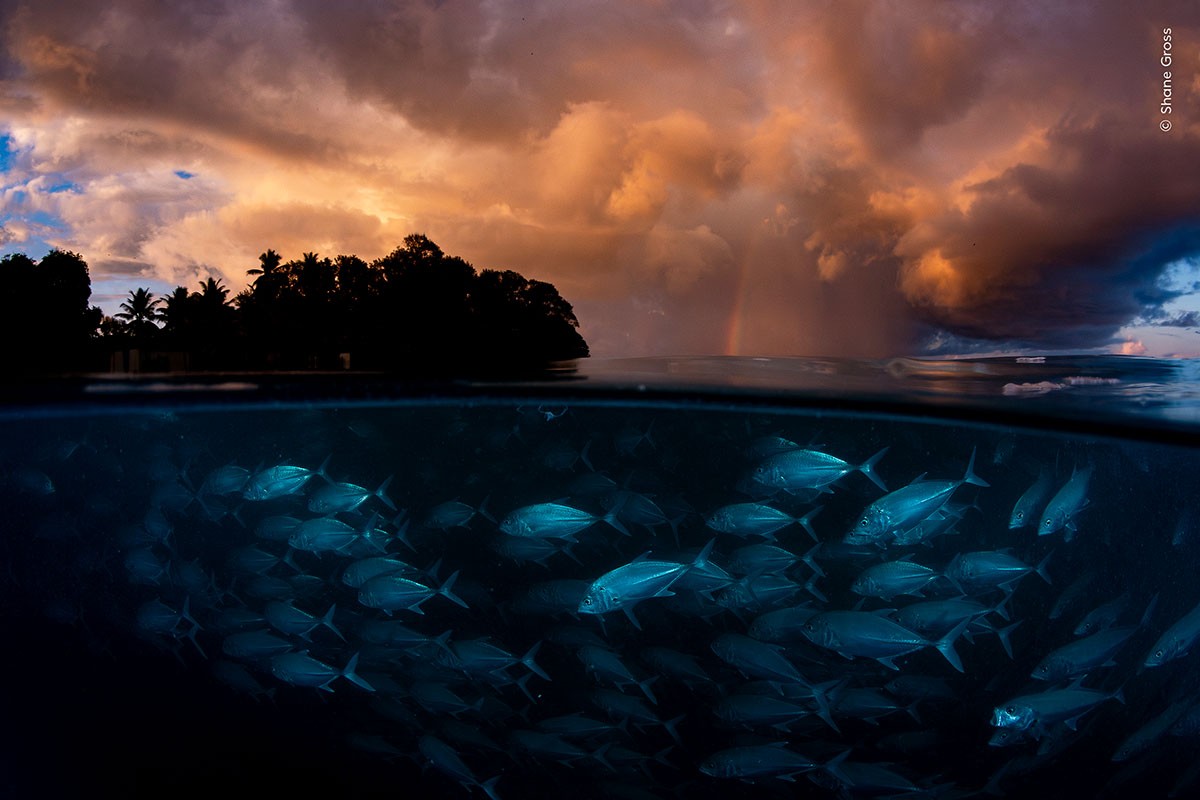
- Calm Amid the Storm by Shane Gross A split shot of storm clouds lit by the orange sunrise contrasted against fish swimming in deep blue water. Overlaid text reads “© Shane Gross”. Every morning at sunrise, Shane spotted this school of bigeye trevally swimming just off the beach of D’Arros Island in the Seychelles. Bigeye trevally are fished by people around the world but this school is relatively safe. The waters around D’Arros Island have been made a Marine Protected Area and a designated no-take zone as part of a worldwide initiative to protect 30% of the planet’s land and ocean by 2030. Composing a split shot – with the lens half underwater and half above – Shane snapped this beautiful photo. The rising sun dramatically lights approaching storm clouds, while the fish mill serenely beneath the waves.
L’ESPOSIZIONE A LONDRA DAL 16 OTTOBRE
Le foto finaliste sono state selezionate da una giuria internazionale di esperti di fotografia naturalistica, cinema, scienza e conservazione, valutandone creatività, originalità, eccellenza tecnica e capacità di raccontare storie legate al mondo naturale. L’intera serie sarà esposta in una mostra al museo londinese a partire da venerdì 16 ottobre. Le immagini saranno accompagnate da contenuti dedicati ai cambiamenti degli habitat naturali, con approfondimenti sul Biodiversity Intactness Index, l’indicatore sviluppato dal Natural History Museum per misurare quanta parte della biodiversità originaria di una regione rimane intatta. L’indice è stato adottato come indicatore ufficiale del Global Biodiversity Framework per monitorare i cambiamenti della biodiversità e i progressi nella conservazione della natura. (Ansa)
Su 24zampe: Scoperta in Thailandia una lucertola che ricorda Syrax di “House of dragon”